Wednesday, October 3, 2012

The 10/3/2012 U.S. Presidential Debate . . . Why it was so Cut-Your-Throat-With-A-Butter-Knife Awful


The 10/3/2012 U.S. Presidential Debate . . .
Why it was so Cut-Your-Throat-With-A-Butter-Knife Awful

I suppose if one is a Mitt Romney supporter it wasn’t awful at all.  The Republican candidate for President did what he needed to do:  look Presidential, not get rattled (except a little), squirt out squid-ink ‘specifics’, pretend that he agrees with most popular Democratic positions, and deep-six the ‘zinger’ strategy.

If one is a Barack Obama supporter, it was pretty damned awful.  And here are some reasons:

--The President looked ashy (yes, that’s a specific call-out to a portion of his constituency . . . where was the oil or lotion?).  He also looked old (honestly, if someone from Mars or Malawi tuned in randomly to this debate, which candidate would seem older?).  One easy thing a 50-year-old candidate has over a 65-year-old candidate is that the former should appear more vigorous, more open to new ideas, more in touch with the current world (not to mention the future), which should translate into an advantage for the younger person.  Uh, dial up Obama-McCain 2008 on the way-back machine.  However, this easy thing did not happen.

--The President spent most of his non-speaking time looking down (At his notes?  His hands?  His wedding ring [it’s his 20th anniversary]? His watch [unfortunately referencing Bush Uno)?).  Apart from giving the impression of being disengaged, this visual tick actually made President Obama look small, as his head was tucked into his chin and his eyes did not engage the camera.  Although Obama and Romney are more or less the same height, Romney (who has a little more beef on his bones, and who uncompromisingly stared into the camera throughout the debate) looked bigger.  This translates visually into more commanding.  More (dare I say it – but statistics bear this out) Presidential.

--Jim Lehrer, the moderator, was a complete pouf.  With the rather free-form debate format, it was up to the moderator to impose some sort of consistent protocol.  This Lehrer did not do, leaving Governor Romney able to horn in on President Obama’s time and change the subject at will.  To be fair, President Obama did little to nothing to counteract this.

--The questions (can one blame Jim Lehrer exclusively? – probably not) were skewed toward wonky economic issues, which are certainly important but which are also boring in the details and are whiffle balls for Governor Romney (not that his answers were all that convincing, but that his answers on economic issues were well prepared, and his comfort level addressing economics is pretty high).  Where were the questions about women’s health?  About the 47%?  About cutting Pell Grants and Head Start?  About immigration?  About funding for NASA and other science and technology initiatives?  [About, dare we say it, encouragement for the arts?]

--In other words, the debate was a dispirited back-and-forth about ill-defined economic goals and easy critiques about what’s wrong with the United States’ economy.  There was nothing about more comprehensive visions targeting what this country should be, can be, strives to be – not to mention how we might make such visions happen. 

The way this debate played out was obviously to Mitt Romney’s advantage.  That he was able to seize this advantage is due, to some extent, to the moderator and the format (and, of course, to Governor Romney’s assiduous and effective debate preparation) . . . but just as much to President Obama, who seemed to me to be sleepwalking through this hour and a half.  Maybe he’d been told one too many times that he couldn’t afford to appear irritated or dismissive.  Maybe he shouldn’t have taken time off to visit the Hoover Dam.  Maybe he just wanted to celebrate his anniversary with his lovely wife.  Maybe he’s truly beaten down by a presidential term that has been stymied at every opportunity by a disgracefully recalcitrant opposition party.  Maybe he’s relying on Joe Biden to save the day next week.

That must be it!

Joementum (the current version, not the 2000 version)!  I’m all in!  Another debate party chez moi. Good friends and political chatter make life sweet.  I might not even need to move to Canada.

Monday, October 1, 2012

A Bipartisan Non-Drinking Debate Game


A Bipartisan Non-Drinking Debate Game

To be honest, non-drinking is optional.  This game adapts easily to shots.  But here’s the dilemma that the game attempts to resolve:

On Wednesday, October 3rd, the first U.S. Presidential Debate of 2012 occurs.  Many of us (including me) are hosting debate-watching parties, excellent excuses for getting together with friends interested in politics.  The problem with debate-watching parties is that often attendees (and hosts) don’t pay much attention to the debates.  Instead, they drink, eat, and chat.  Which of course is the point of most parties.  But what if you, and most of your friends, actually want to watch the debate as well as enjoy conviviality?

I suggest having a contest . . . an easily played game that requires paying attention to what the nominees and the moderator are saying.  To persuade people to play, have a prize.  For example, I have an eight-year-old John Kerry Frisbee that would be a swell reward for winning.  I also have an extra Alben Barkley sunflower campaign button.  If these don’t move you (or you don’t have overflow campaign memorabilia), try a six-pack of Pabst Blue Ribbon.

Procedure:   In any event, invite your friends to come over at least an hour before the debate.  Have plenty of drinks (alcoholic and non-), plus some sweet and some savory snacks (reserve full dinner for election night).  Download this game sheet, and hand it out, along with pencils. Have people make their guesses/predictions, and sign their sheets. Collect the sheets, shuffle them, and hand them out randomly, so that people will score them relatively accurately.  Pour the second round of drinks and start to watch the actual debate. (Third and fourth rounds are permissible during ad breaks.) 

Rationale: Your guests should be paying attention because (1) they want to win and are trying to remember what answers they gave; because (2) they’re among friends, so they want to be fair; and because (3) for many questions, they must count the number of occurrences (of a phrase, of a mention, etc.).  Occasional disputes about whether an answer is true or false will happen, which is all to the good.  This is a party, after all.  Once the debate is over, calibrate the game sheet (every correct answer is awarded one point), name a winner, and award the snazzy prize.  More drinks can then be enjoyed.

Outcome:  Your debate-viewing party people will have really watched the debate, without sacrificing vocal interaction and friendly ribbing.  This strategy should work whether it is a mixed- (Republican and Democratic) or single-party group.

The following is a sample game sheet for the first upcoming debate, on domestic policy.  You certainly can adapt the questions to fit issues you think are most important, and in the future change the questions to mesh with debates that have different focuses.  Principals in the 10/3 debate are:  President Obama, Governor Romney, and Moderator Jim Lehrer.  The lack of honorifics in the questions below should not be read as a sign of disrespect but as a sign of saving printer ink.


Debate Game:  10/3/2012

_____Obama wears a blue tie; Romney wears a red tie.  [T]  [F]

_____Lehrer asks a question about voter suppression.  [T]  [F]

_____Romney says the word ‘abortion’ more than Obama uses the phrase ‘women’s health.’ [T]  [F]

_____Romney mentions Paul Ryan more than Obama mentions Joe Biden. [T]  [F]

_____Obama says ‘ummh’ more than Romney says ‘if you will.’ [T]  [F]

_____Romney laughs (ha-ha) more than Obama flashes a big smile. [T]  [F]

_____Lehrer asks about Republican support of Todd Akin. [T]  [F]

_____Obama uses the phrase ‘economic patriotism’ more than three times. [T]  [F]

_____Romney uses the phrase ‘tax cuts’ more than ten times. [T]  [F]

_____Lehrer asks about the auto bailout. [T]  [F]

_____Obama mentions his wife Michelle more times than Romney mentions his wife Ann. [T]  [F]

_____Romney uses the phrase ‘saving Medicare’ more than Obama does. [T]  [F]

_____Obama uses the phrase ‘saving Social Security’ more than Romney does. [T]  [F]

_____Lehrer asks about Wall Street regulation. [T]  [F]

_____Romney uses the phrase ‘Middle Class’ more than Obama does. [T]  [F]

_____Obama uses the phrase ‘1%’ more than five times. [T]  [F]

_____Romney gets more standing ovations than does Obama. [T]  [F]

_____Lehrer asks about infrastructure. [T]  [F]

_____Obama looks down and scribbles in a notebook or equivalent more than Romney does. [T]  [F]

_____Romney makes the three-point sprinkler turn (left-middle-right full-face-ahead) more than four times. [T]  [F]

May the best debate-viewing party participant win!


Monday, September 24, 2012

Swing State Blues


Swing State Blues

They call us undecided;
            We’re still sitting pretty on the split-rail fence.
The electorate’s divided,
            All these ads have made us ornery and tense.
As the pundits have confided,
            We Tarheels are recalcitrantly dense.

To messages from both camps,
            We plug our ears and hold our breath and bitch.
One guy is king of food stamps.
            The other guy is very, very rich.
They’re GOP and Dem champs,
            But we don’t know which is which.

            We’ve got the swing state blues
                        We don’t read the news
                                    We’ve got the swing state blues
                                                We refuse to choose
                                                            We’ve got the swing state blues.

Government should be smaller:
            Keep your hands off my old granny’s Medicare.
If Rush takes another caller,
            I’ll tell him that he’s choking on hot air.
If Reverend Al were taller,
            I’d make him eat Clint Eastwood’s empty chair.

Barack saved General Motors,
            But Mitt Romney keeps the immigrants at bay.
Black helicopter rotors
            Remind us that they’ll take our guns away.
Low-information voters?
            We know enough to stay at home election day.

            We’ve got the swing state blues
                        We don’t read the news
                                    We’ve got the swing state blues
                                                We refuse to choose
                                                            Reconquer Indochina,
                                                            Plus Mecca and Medina . . .
                                                            Stay out of my vagina!
                                                            We’ve got the North Carolina
                                                                        Swing State Blues.


Wednesday, September 19, 2012

Mittie the Moocher


Mittie the Moocher

He gave her his townhouse and his racing horses,
Each meal she ate was a dozen courses,
She had a million dollars worth of nickels and dimes,
She sat around and counted them all a million times.
            --Cab Calloway, “Minnie the Moocher,” 1930

Like many people interested in politics, I spent much of yesterday mesmerized by coverage of Mitt Romney’s “secret tapes.”  It’s hard to say what aspect was most entertaining, the candidate’s stupefying lack of logic or the buzzard flash mob quickly conjured by panicky conservative pundits.  On the first point:  hmmm, I did and will vote for President Obama, which puts me and most of my family and friends in the 47% who, because we won’t vote for Governor Romney . . . don’t pay taxes, see ourselves as victims, get government handouts, and have no sense of personal responsibility.  That would be no, no, no, and no.  On the second point:  if the enemy of my enemy is my friend, does that mean I now have to subscribe to the Wall Street Journal and the Weekly Standard?

[For those who haven't heard or read the remarks, here's a link to the complete surreptitious video:
http://www.motherjones.com/politics/2012/09/watch-full-secret-video-private-romney-fundraiser]

A tune started to play in my head while I watched Mitt Romney dismiss half of the American electorate – Cab Calloway’s “Minnie the Moocher.”  This terrific jazz/blues/scat song was composed near the beginning of the Great Depression; it alternates between narrative lyrics and call-and-response scat singing.  The ‘story’ of the song concerns Minnie’s attempts to sponge off rich men (including the “King of Sweden” who “gave her things that she was needin’”).  Unfortunately, the wages of mooching are sin and ruin; Minnie hooked up with “Smokie,” who in turn hooked her on cocaine and opium.  We are left, after a bravura barrage of scatting, with the plaintive refrain, “Poor Min, Poor Min.” 

Here are two versions of the song:
        --an excellent early recording (not a video)

        --a fun video showing Cab Calloway and his orchestra in full performance mode, from The Blues Brothers (1980):

The moral of the song, if one cares to extract one, is the same as the moral Mitt Romney was pushing in Boca Raton.  ‘Moochers’ – those who live off the largesse of others – are weak, dissolute, and a drag on society.  The song can also be read as a lament for or critique of the excesses of the Roaring Twenties, when fun, overindulgence, and magic money seemed to bury the Puritan work ethic.  Similarly, people like Governor Romney appear to run on nostalgia fumes generated by a mythology of better, simpler, more ‘American’ times before they were ruined by entitlements, immigrants, and redistribution of wealth.

I love Cab Calloway, and I feel silly burdening his wildly inventive song with ideological descants (even in the service of semi-satirical commentary).  Nonetheless, I’m not the only one to do so.  In 1932, the animation pioneers Max and Dave Fleischer released a cartoon version of “Minnie the Moocher,” starring Betty Boop, her canine boyfriend Bimbo, and Cab Calloway as a menacing ghost walrus.

This has got to be one of the greatest cartoons ever.  Luckily, it’s available online:


The moral remains the same, but the terms have shifted.  Betty Boop decides to run away from home after being scolded by her parents for irresponsibility.  She climbs out her bedroom window at night, joins Bimbo, and they end up in a hallucinatory, sexualized Plato’s Cave in which spectral figures materialize to the strains of “Minnie the Moocher,” conducted by the Walrus (goo-goo-g’joob – the walrus was animated using the Fleischer rotoscope process, in which cartoons are drawn directly over filmed images . . . in this case, of Cab Calloway performing the title song).  Skeletons drink poison booze (which turn their bodies black – make of that what you will), ghosts are electrocuted, phantasmal kittens cannibalize the body of their phantasmal cat mother.  Surrounded by these horrors, including a particularly disturbing ululating witch, Betty and Bimbo flee the cave for the safety of “Home, Sweet Home.”

The Fleischer cartoon foregrounds the original lyrics’ sexual component (Minnie was a “red-hot hootchie-cootcher,” i.e. a prostitute) and turns them into a cautionary tale.  Betty Boop – although drawn as a sexually seductive woman – is also a ‘good girl’ living with her parents.  Leaving the shelter of home (with her boyfriend, no less) exposes her to all sorts of physical and emotional dangers.  That she ends up safe in bed – alone – underscores the value of obedience and chastity. 

Again, reading a brilliantly surreal cartoon seriously does a disservice to its delightfulness.  Yet watching the depression-era “Talkartune” brings up a few other dimensions of the current discussion about ‘mooching.’

Betty Boop, deterred from a life of dissolute ‘mooching,’ is saved from being a victim.  Victimhood is sexualized – it’s a female thing that happens to the weaker sex, particularly when women don’t listen to their fathers or father figures.  Why does this remind me of the recent controversies about abortion, rape, and even birth control?  Why is it always ‘Welfare Queens’ who suck money and freebies from the public tit, rather like the rapacious ghost kittens in Fleisher’s cartoon? 

Mitt Romney’s remarks in Florida, and his disastrously premature remarks about violent unrest in North Africa, exhibit an odd hyper-masculinity.  We should never apologize, never be weak, never show our taxes, never condescend to listen to people with whom we don’t agree, never coddle those in difficult circumstances.  We should draw lines in the sand and be ready to bomb the hell out of any place that doesn’t recognize our irrefutable supremacy and moral rectitude.  We should be Leaders from Outfront rather than Leaders from Behind (that would be: followers).  We should be Makers, not Takers.  We should be Ayn Randian Capitalist Heroes in public, and firm but fair Paterfamiliases in private. 

Those who don’t fit into this equation are feminized in Romneyesque discourse.  They apologize and sympathize.  They think that hope-and-change fairy dust can solve real problems.  They are weak and lazy.  They lack responsibility.  They are freeloaders. They are infected with ‘foreignness.’ 

And so on. 

Both in Calloway’s song and the Fleischers’ cartoon, Minnie mooches (or might mooch) off men because that’s the only course open to her.  New Deal programs were not enacted until later, so living on the government ‘dole’ was not an option.  Today, the social safety net first woven in the 1930s, though frayed and threatened, remains in place, as do the gendered roles assigned to the provided and the provided for.

So as we wimpy 47-percenters swan around our government-subsidized housing counting food stamps, we think back to when we were manfully employed.  I don’t know about you, but my average tax rate has been around 30%.  I have no recourse to exotic tax shelters, or even to many deductions.  One could argue that hugely rich men who do have such recourse, and take advantage of it, could be justly described as ‘moochers.’  Unless, according to Mitt Romney’s logic, they are Republicans. 

Oh well.  Barring some catastrophe, we may be witnessing the end of Governor Romney’s viability as a Presidential candidate.  As cranky Conservatives call for his head, or his campaign chief’s head, or advisors and pollsters and strategists’ heads, they may be sealing his fate and guaranteeing the outcome that they don’t want:  four more years of Barack Obama and the supremacy of tax-evading, negligent, government-dependent slacker-citizens.  Which might make Mitt Romney adopt a new favorite song, the song Betty Boop sings in the Fleischers' “Minnie the Moocher” when she cries over her parents’ attempts to make her a responsible young woman:

They always, always pick on me;
They never, never let me be . . .
When I’m  gone, you wait and see,
They’ll all be sorry that they picked on me.

To which the 47%, now swollen to 51% or more, could reply, in Cab Calloway’s immortal words:

            Oh, skip-bop-doop-bop-lay-de-doo!
            Skee-bop-de-google-eet-skee-bop-de-goat!
            Skeet-dot’n-dot’n-dot’n-dot’n-dottee-oh!
            Hi-de-hi-de-ho!  Hi-de-hi-de-ho!


Tuesday, August 28, 2012

Michelle Obama, Fuzzy Jesus, and the Value of Art


Michelle Obama, Fuzzy Jesus, and the Value of Art

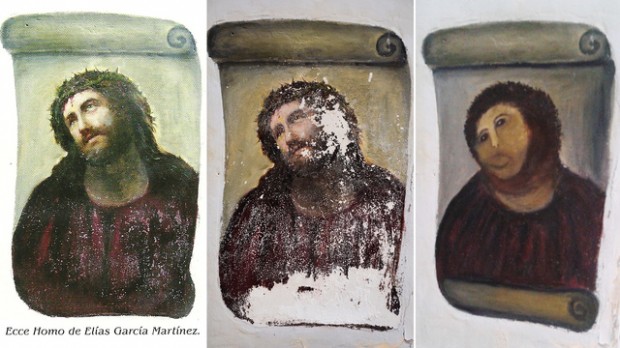
It’s the Republican Convention (yawn, stretch, snooze), so I want to think about something else.  This week, there’s been a micro-explosion of news-garnering art alteration, most notably an octogenarian’s hilariously mishandled ‘restoration’ of a 19th-century Spanish wall painting of Jesus (bottom triptych, above).  But Spain has given us another fascinating case, one that isn’t yet as well-reported as is the Simian Christ.  It’s a cover for the Magazine de Fuera de Serie.  The artist is Karine Percheron-Daniels, who photo-chopped Michelle Obama’s head (top left, above) into an 1800 oil portrait of a Caribbean slave (top right, above).

To me, the interesting thing about Fuzzy Jesus (after initial delight in the bizarre horridness of the paint-over) is the reaction to it. Overwhelmingly, public opinion (at least as we can tell via the internet) has been on the side of the Ewokian Son of God.  There are petitions to save it (after initial calls to re-restore the conventional painting that it pretty much obliterated).  There are mock justifications of its theological depth, such as that it critiques Bible-based Creationism by depicting the Christ as, more or less, the Missing Link.  There are less ironic justifications of the botch-job, such as it is a subtle (???!!!) commentary on the unconsidered transmission of visual tropes and a jab at the authority of the art-historical canon.  There are capitalist reception-theory views of the work, such as noting that tourists are flocking to the previously obscure site in order to view the new objet célèbre, in the process bringing much-needed cash to the church and the town.  And there are the rather plaintive calls by relatives of the 19th-century artist, Elias Garcia Martinez, to restore/recreate the original, not to mention municipal threats to charge the aged ‘restorer’ with vandalism.

Upshot?  The Santuario de Misericordia in Borja, Spain, is experiencing a decided uptick in visitors, Elias Garcia Martinez has been catapulted from (to me) deserved obscurity (the painting was not only derivative, it was done badly – painted directly onto the wall as opposed to a prepared surface, which is why it had flaked away so quickly) into art-historical recognition, and the ‘restorer’ will no doubt reap monetary rewards (paid interviews if nothing else) from her brush-wielding intervention.  Win – win – win! 

Let’s switch to the Michelle Obama-as-slave/courtesan magazine cover.  Again, this is an ‘art intervention,’ here using modern (Photoshop and its clones) rather than traditional (brush and paint) tools to modify a previously existing image.  The original, painted by Marie-Guilhelmine Benois in 1800, lives in the Louvre (probably in the Louvre’s storage facilities, as I doubt it has been on permanent display recently [but that may change]), rather than on a church wall.  Benois was a pupil of the neo-classicist master Jacques-Louis David, and in its time, her painting was relatively well known but subsequently consigned to the obscurity that the art-historical canon can so readily confer, particularly (until recently, perhaps) on female artists.

The controversy, such as it is, about the Michelle Obama cover is whether it repeats and exploits racist and sexist stereotypes.  The first:  the artwork depicts the First Lady as a slave or at least as a newly emancipated 'fancy woman.'  The second:  the artworks sexualize both subjects, as evidenced by the exposed breast (different online reports on the cover show it with a blurred torso or, as in the image I reproduced above, a ‘starred’ nipple). 

Nothing I’ve read about the magazine cover is ironic, or even acknowledges the tantalizingly peculiar disconnect between the present subject (Michelle Obama) and the original subject (a slave/mistress from Guadeloupe).  Nor do commentaries (and there aren’t many of them, to date) bother to address what the current artist thought she was doing with this image or how the magazine, in its article about Michelle Obama, tried to depict her – not to mention how the original painting was conceived and received. Instead, the cover is condemned as ‘obviously offensive’ and ‘racist.’

Some things to think about:
--The Michelle Obama image was not commissioned by the Spanish magazine. Magazine Fuera de Serie simply bought the rights to what was part of a preexisting (and, one assumes, ongoing) series depicting famous contemporary women as subjects of canonical art works, usually ones featuring the female nude.  Example:  Queen Elizabeth as a heraldic Renaissance/Baroque emblem.  Another example:  Marilyn Monroe as a classical Odalisque.


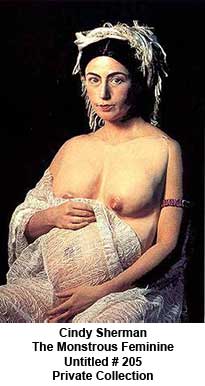
--How different is this series from the works of Cindy Sherman, the most celebrated and highest-priced female artist (her medium is photography) in the world?  Ideologically speaking, not much.  ‘Originality’ speaking, Sherman takes the tiara, as her projects predate Percheron-Daniels. Value-speaking . . . the fact that Sherman’s works have blown the roof off photographic sales prices (she holds the record at almost $4million per print) makes it an unfair contest.  But if even low-level controversy is generated by the Magazine Fuera de Serie cover . . . it’s a good bet that Percheron-Daneie’s prices will soar.  So that’s one aspect of value.


--How less ‘original’ is this image from the many riffs on an ‘original’ that are canonized in Western Art history?  It may be less interesting or well done, but the fact that it’s a riff should not be disqualifying. As an example, some canonical Odalisques (not counting Marilyn Monroe, above) by (top to bottom) Titian, Ingres, Gauguin, and Matisse:


--The cover image is one thing, obviously chosen (paid for) to generate interest and sales (value).  The article is another.  Its subtitle is: “Michelle Tataranieta De Esclava, Dueña De América” (more-or-less literal translation:  Michelle Great-Great-Granddaughter of a Slave, Lady of America).  It praises the First Lady (and at least tacitly, the United States), and its slant is on the huge changes that have affected African American women over two centuries. 

--The Benois painting was meant to celebrate France’s emancipation of its slaves (although, ironically, that emancipation did not stick in Guadeloupe for more than a couple of years) and to celebrate the agency of former female ‘chattel.’  And that’s how it was valued by what was then in Europe the ‘Progressive’ faction.

--As ‘Progressive’ politics have understandably changed during the 20th and 21st centuries, and as Feminism has influenced Progressivism, much attention has been focused on how women – particularly non-white women – are sexualized (to serve the underpinnings of patriarchy, to serve the gendered ideology of colonialism, to serve the goals of Capitalism).  Thus, the offending bared nipple.  Thus, the automatic contemporary devaluing of this artwork.

--European art has a long tradition of female nudes.  American (viz, United States) art has much less of this tradition because of, to simplify, the Puritan double inheritance of sexual discomfort and iconoclasm (and perhaps also a general supercilium about European art and its topoi).  Therefore:  a devaluing of nudes, or partial nudes, as artistic subjects. 

So should U.S. citizens today be highly offended by the Spanish magazine cover?  I think:  no.  The image was selected to add value (sales) to a periodical by, certainly, injecting some look-twice value (if it had been an American magazine, we would say ‘shock value’) and – who knows – to add value to a European woman artist who’s done some interesting, if not exactly ground-breaking, projects. I'll go so far as to say that Michelle Obama (pace the offending nipple) looks beautiful, regal, and powerful in this pastiche.

I could even argue that, like Fuzzy Jesus, the image deliberately or non-wittingly challenges artistic and ideological stereotypes, as well as putting into focus the conditions that determine artistic ‘value.’ 

As an undergraduate Art History major, I retain vestiges of ‘universal value’ as a silent but deep current of how art is judged.  As a person with a doctorate in literature and literary theory (and as someone who’s considerably older than she was as an undergraduate), I doubt the validity of ‘universal value.’  But doubting ‘universal value’ as a given truth, like the law of gravity or the inevitability of death, does not mean doubting ‘value’ as an important part of how we see ourselves and our world and our art and even our beliefs. 

In whatever realm of endeavor and existence, thinking about value . . . what one means by value . . . who does the valuing . . . what forces influence valuation . . . is, to me, a good thing.  Thus, at least transient salute to Fuzzy Jesus and to Pecheron-Daniels’ ‘portrait’ of Michelle Obama for making me think, and think again.

So, for the final rethink (for tonight):  the Santuario de Misericordia Jesus 'restoration' is pure kitsch -- something so aesthetically atrocious that it's compelling.  Its value (as 'ironic art,' as tourist attraction) will be fleeting. In contrast, Karine Percheron-Daniel's work has serious conceptual weight, even if it's not altogether novel, even if its medium is not yet seen as fine-art-ish and, frankly, even if its craft is a bit shaky (the color tones of the superimposed head and the pre-existing body do not match very well).  So, despite its shortcomings, I'd rate it higher as a potentially valuable work of art.  But then again, we can't underestimate the power of a haunting image like Fuzzy Jesus, particularly if it goes viral in today's unexplored terrain of virtual value-creation.  Who will ever forget this image, and isn't remembering beyond the fifteen-minutes of fame Warhol allotted (back in the pre-internet days) the sign of something  . . . valuable?


Tuesday, August 21, 2012

Phony Distractions? 'Legitimate' Rape and Personhood


Phony Distractions?  ‘Legitimate’ Rape and Personhood

Today’s news is bursting with comments about and condemnations of Missouri Republican Senate Candidate Todd Akin’s opinions about how, in cases of ‘legitimate rape,’ women’s bodies produce mysterious abortificants that prevent pregnancy.  And that if these magic, unknown-to-science secretions fail to work, either the rape was not ‘legitimate’  (I guess that the woman really solicited or wanted or enjoyed the attack, and/or she wasn’t beaten senseless) or . . . too bad, the rape-engendered zygote should not be ‘punished’ in any event.

Almost anyone who might read this blog knows this, and has followed the Republican stampede to distance the party from Akin’s stunningly ignorant remarks.  Thus what I’d like to discuss is not the (probably soon-to-be ‘former’) Senate Candidate’s remarks per se but the timorous spin being put on them not only by most Republicans but also by the media at large.

The Republican establishment, including Candidate Romney, have scurried about trying to separate themselves from Akin’s remarks, suggesting that they’re an unfortunate distraction and that very few people agree with the Missouri Senator wanna-be’s views.  Most media commentary has followed suit, at least for the first day after the remarks, commonly by focusing on how these distracting ‘extreme’ views may hurt down-ticket as well as up-ticket Republican prospects.

Distraction?  No way.  Akin’s ideas are just the latest in a mighty stream (in which justice has not rolled down) of Republican/Conservative/Tea Party pronouncements about women’s health and responsibility for their own bodies, which to most sane people {but not the Republican Party as currently constituted) include at least some small measure of reproductive choice, particularly in dire circumstances. 

Thus Akin is not a ’distraction.’  He is a particularly obnoxious and frightening example of what now is mainstream Republican thought about women, their bodies, and their progeny . . . and of not-to-be-disputed male prerogative over women.

We should not forget that Akin and Paul Ryan cosponsored a Federal ‘Personhood Act’ (every fertilized egg is a person, and therefore interfering with its growth is an act of murder), and they both supported the bill that tried to redefine the ‘rape exception’ in the Hyde Amendment.  The original version of this bill, the “No Taxpayer Funding for Abortion Act” (H.R. 3), gave us the term “forcible rape” to specify the only sort of act that can cause an abortion-worthy pregnancy.  This language was expunged from the final version of the bill – but smuggled in through the back door via the addition that the bill will "not allow the Federal Government to subsidize abortions in cases of statutory rape." 

In other words:  same thing.  Statutory rape = non-forcible rape = not rape at all.

What’s the difference between Akin’s “legitimate” rape and the House Bill (supported by all Republicans) terminology of “forcible” rape (then finessed into non-statutory [that would be forcible, I believe])?

There’s another link.  Far right-wingers have been promoting the 18th-century idea of virtuous female trauma acting as spontaneous birth control for years and years.  Example:  in 1995, a North Carolina Republican State Representative claimed,   "The facts show that people who are raped -- who are truly raped -- the juices don't flow, the body functions don't work and they don't get pregnant. Medical authorities agree that this is a rarity, if ever."  Another example:  in 1988, a Pennsylvania Republican State Representative stated that the odds a raped woman will get pregnant “are one in millions and millions and millions” because the rape causes a woman “to secrete a certain secretion” that’s evidently extremely unfriendly to sperm. As recently as 2003, Georgia Republican Don Thomas put it quite succinctly: “Women don’t get pregnant through rape.”

Here’s the logic:  if really truly forcibly legitimately raped women can’t get pregnant, then it’s OK to allow abortions in these cases – because there won’t be any!  All one has to do is ban abortions for ‘non-forcible,’ ‘illegitimate,’ ‘false’ (Akin’s latest offering, as of August 21), or plain old statutory rape, and abortion will be gone for good.

This is the rationale between so many of the Republican-sponsored bills attempting to curtail abortion, both on state and national levels.  It’s a rationale that Paul Ryan supports, if his voting record tells us anything about how he thinks. 

In light of the party’s record, Republican claims that Akin is a ‘distraction’ are just as infuriating as are Akin’s comments.  Distraction from what?  The current Republican Party’s actual views about women’s health issues, which have been massively in synch with Todd Akin’s ideas? 

Trying to explain women’s supernatural ability to prevent conception when, evidently, the sexual act was not in some measure agreed upon, Todd Akin said:  “The female body has ways to try to shut that down.”

Word.

The female body politic has ways to shut down misogynistic, stupid, and harmful public policy.  It’s called voting.  It’s called widening the gender gap so that no knuckle-dragging (right on for once, John Boehner!) candidates are elected.  It includes valuing ourselves, our daughters, our daughters-in-law, our granddaughters  . . . valuing all women’s full ‘personhood.’  Yes, even valuing our own mental and physical health over that of a few-days’-existent conglomeration of cells. And in addition, valuing the fact that we who’ve experienced the excruciating event of a rape, either inflicted on us or on loved ones, know that male-legislated slicings-and-dicings of what ‘rape’ means are unspeakably upsetting. 

All women [and maybe even most, or at least some, men] understand when ‘rape’ is ‘rape.’  Gun to the head, knife to the throat, trapped in a small space by a much larger male . . . and also, from another perspective, being too young to understand what’s happening, complying to save oneself from what seems like certain catastrophic harm, or not being able to do much of anything because one’s faculties have been compromised . . . it’s all rape.  Legitimate and forcible.

Again, people who say otherwise, like Todd Akin, are not ‘distractions’ when they are simply voicing commonly held (among their co-ideologues) ideas about rape and what constitutes a ‘person’ and which categories of ‘persons’ trump other categories. National Republican candidates need to do much more than run away from newly-identified-as-extreme Akinesque comments. 

They need to rethink their whole approach to women’s health, to reproductive rights, and to the policy planks soon to be revealed in Tampa (actually, one has been revealed this morning:  the Republican Party opposes abortion in all cases, no exceptions).  That’s where the rubber (oops, sorry to mention a means of birth control) will meet the road.


Sunday, August 19, 2012

Objectivist Economic Lessons from Honey Boo Boo


Objectivist Economic Lessons from Honey Boo Boo

Toddlers & Tiaras is the horrifyingly hypnotizing ‘reality show’ about children’s beauty pageants.  Its new spin-off, Here Comes Honey Boo Boo, is just downright horrifying. It follows the exploits of a rural Georgia family as they interrupt their slovenly lives and quaint pastimes (mud-diving, discount pedicures for four-toed gay uncles) to help their 6-year-old Alana (aka Honey Boo Boo) pursue the ever-elusive rhinestone-and-pipe-cleaner crown.  Honey Boo Boo is particularly fond of baring her tummy, caressing it, and making it produce a symphony of gross sounds.

Who watches this disgusting drivel (well, other than certain bloggers who prefer to remain anonymous)?  Who believes there’s something to learn from this family?

Perhaps Paul Ryan and other devotees of the execrable writer and simplistically juvenile philosopher, Ayn Rand.

Honey Boo Boo’s relatives (her 300-pound mother June, her father Sugar Bear, her half-sisters Pumpkin, Chubbs, and Chickadee, and her pet pig Glitzy) form a wonderful example of how Ayn Rand’s Objectivist worldview (espoused early and often and publically and globally, until about five days ago, by Paul Ryan) can be realized in 21st-century America. 

They show that poor people can take care of themselves perfectly well, thank you very much.  No social safety nets needed.  (Indeed, no social safety net could hold them.) The Boo Boos (they have a variety of last names, as their legally recognized connections are complicated, so it’s easier to refer to them as a conglomerate) are just the sort of self-reliant bootstrappers that Paul Ryan (and presumably, now the Romney-Ryan ticket, not to mention the early Ayn Randian, Justice Clarence Thomas) would hold up as models for emulation, following Rand’s belief in the triumph of the unfettered sovereign individual, thanks to free-market capitalism’s will-to-power.  As Honey Boo Boo herself proclaims, she’ll “hollah for the dollah.”

Who needs food stamps when, with enough initiative, you like the Boo Boos can scoop up road kill and transform it into a winter’s worth of hearty, if hygienically compromised, provisions? To supply side dishes for squished-venison sausage and decapitated-skunk stew, Honey Boo Boo’s family amasses coupons in quantities enough to put most local landfills out of business.  According to Mama June, they are ‘extreme couponers’ who can parley a shopping bag full of paper scraps into a pick-up truck full of useful items like stale Pringles and Little Debbie Snack Cakes. 

If they’re still in need of basic comestibles, they attend “Food Auctions,” where you can bid on lots of sell-date-expired processed food (which is saying a ton, considering that the chemical composition of much processed food resembles the half-life of cockroaches).  In a recent episode, the Boo Boos purchased approximately five cartons of plastic-enclosed once-upon-a-time baked goods for only two dollars.  (Which neatly parallels the Ryan [Ryan-Romney?] plan for rescuing Medicaid and/or Medicare:  save some money, then spend the savings on things that are absolutely worthless, like more money shoveled into the already bloated Health Care Industry.  If you’re an individual unhealthy person, do what the Boo-Boos do: deny or ignore that there’s any thing wrong.  That way you won’t waste any money at all on health care.  As Mama June stated, it’s fine with her if her daughters weigh 1,000 pounds each – and if other people don’t approve of it, they can just stuff it.) 

Extreme Couponing, as disclosed in a recent episode of Here Comes Honey Boo Boo, demonstrates another bedrock principle of Rand and Ryan’s Objectivist philosophy.  Selfishness is all.  If it takes a supermarket clerk five hours to process your mountains of ten-cent-off coupons so you can buy enough cheap toilet paper to stock every survivalist bunker from Georgia to Wyoming, so be it.  The people behind you in line SHOULD suffer, seeing as how they were fruity-pants enough to come to the store bearing only a wallet’s worth of coupons.  And the unlucky checker?  If he’d had enough gumption, he’d have owned the darned grocery and a whole lot more.  Sort of like John Gault (Atlas Shrugged hero).  And if he didn’t like how his grocery stores were operating, he’d blow them up.  Sort of like Howard Roark (The Fountainhead hero).  No compromise!

Nor do we need anything like government family planning initiatives.  (Oh . . . whoopsie . . . Ayn Rand, in a sort of intellectual eugenic dithyramb, supported birth control and abortion.  But Paul Ryan doesn’t, under any circumstances . . . one of the reasons Ryan has conveniently and VERY recently started to moonwalk back from his ideological muse.)  So for Ryan, in any event, the spewing out of unplanned-for children (Mama June had Chickadee when June was fifteen . . . Chickadee [mid-teens, no baby father in sight] is pregnant) must be a good thing.  More good-governing lessons (or ‘less’ ins) from the Boo Boos.

Of course, the most awesome Objectivist trait of Honey Boo Boo and her family is the fact that they have their own TV reality show.  And without the equal-time Communist nonsense that the Obama Reich has been trying to impose!  Guess there’s no Reality TV program about a family in which members have jobs, pay taxes, send their kids to college, refrain from farting in public, and don’t get pregnant in middle school!  I mean, be serious – who’d watch unless Uncle Joe Stalin implanted tiny receivers in their brains before shipping them off to the Gulag to write subversive movie scripts?

Which brings up another swell Ayn Rand Objectivist Trait:  being a craven ratfink, which is an excellent ability if it saves your own Objectivistly worthy-of-being-saved skin.  Rand, who made much of her living as a Hollywood screenwriter, was in the vanguard of those who tripped over themselves to testify in the McCarthy-era “investigations” of “Communist influence” in Tinseltown, passing on rumors and making things up in order to advance their own careers and destroy the careers of others.  Rand’s heroes would have done no less.  Nor would many other parents featured in Toddlers and Tiaras and its Reality TV clones.

To be fair, the Boo Boos seem less prone to bad-mouth other contestants than do many televised child beauty pageant parents.  Maybe the Boo Boos’ noisome participation in the ‘Morality of Capitalism’ (Paul Ryan’s words describing the timeless ideological appeal of Ayn Rand) doesn’t leave them time to calumniate lesser mortals (or ‘parasites,’ in Ayn Rand’s words describing the poor, the disabled, and the unlucky . . . and maybe those who don’t ‘pull out’ for the Ultimate Grand Supreme Crown).  Or maybe the sunny and funny disposition, and apparently bright mind, of Honey Boo Boo herself (I’m not kidding here – she seems like a rather sweet and intelligent child, despite her coarse nurturing and/or the way that nurturing is displayed on television) keep her family from coming across as complete moral monsters.

Speaking of morality:

Not too long ago, many people (perhaps including the anonymous blogger referred to above) made fun of George W. Bush for stating, in response to a Presidential Debate question, that Jesus Christ was his “favorite philosopher.”  But if we compare the choices now before us through the prism of Honey Boo Boo (as she and her folks are portrayed) and of the Randian Objectivism that seems to have been operating much more forcefully in our culture than most of us thought . . .

The Synoptic Gospels don’t agree on everything, but they do suggest that Jesus was committed profoundly to some variety of social justice and compassion. Despite extra-canonical documents like the Gospels of Thomas, Judas, and Mary (which put forth a more Gnostic, kingdom-within-you view of Jesus’ teachings), Christianity in its many current forms basically agrees on the divinely mandated importance of helping the less fortunate.  So does Judaism (he who saves one person saves the world).  So does Islam, in which practiced charity is one of the five ways one becomes a Muslim.  So do Boddhisatvas, who remain in the round of rebirth in order to help all beings achieve ultimate peace. 

So, seriously, do many atheists, who agree on the ultimate moral importance of social justice and compassion. Without believing in a divine mandate, most atheists I know think that since all we have is what we are/experience/do in this world, we’d better act as thoughtfully and as humanely as we possibly can or else our heart-stoppingly finite existence means absolutely nothing.

But Ayn Rand was not that sort of atheist.  At least in her public life (which is the sum total of what almost anyone, including Paul Ryan, knows of her), she was all-for-one, and that-one-is me, all the time.  Which is another reason Ryan is disavowing his life-long admiration of her right now, as atheism of any ilk does not play well with the electorate.  At least the Boo-Boos take care of each other, even if it’s keeping bellies full with stale loaves and beached fishes.

Atlas shrugged.

Jesus wept. 

Honey Boo Boo rubbed her tummy.