Tuesday, August 28, 2012

Michelle Obama, Fuzzy Jesus, and the Value of Art


Michelle Obama, Fuzzy Jesus, and the Value of Art

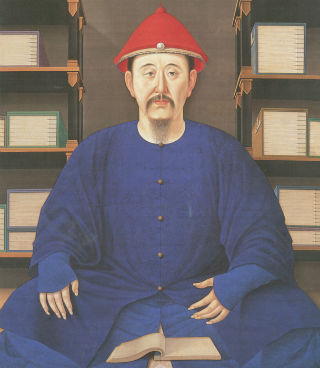
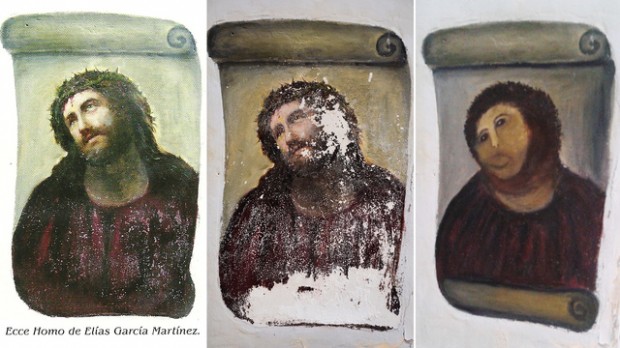
It’s the Republican Convention (yawn, stretch, snooze), so I want to think about something else.  This week, there’s been a micro-explosion of news-garnering art alteration, most notably an octogenarian’s hilariously mishandled ‘restoration’ of a 19th-century Spanish wall painting of Jesus (bottom triptych, above).  But Spain has given us another fascinating case, one that isn’t yet as well-reported as is the Simian Christ.  It’s a cover for the Magazine de Fuera de Serie.  The artist is Karine Percheron-Daniels, who photo-chopped Michelle Obama’s head (top left, above) into an 1800 oil portrait of a Caribbean slave (top right, above).

To me, the interesting thing about Fuzzy Jesus (after initial delight in the bizarre horridness of the paint-over) is the reaction to it. Overwhelmingly, public opinion (at least as we can tell via the internet) has been on the side of the Ewokian Son of God.  There are petitions to save it (after initial calls to re-restore the conventional painting that it pretty much obliterated).  There are mock justifications of its theological depth, such as that it critiques Bible-based Creationism by depicting the Christ as, more or less, the Missing Link.  There are less ironic justifications of the botch-job, such as it is a subtle (???!!!) commentary on the unconsidered transmission of visual tropes and a jab at the authority of the art-historical canon.  There are capitalist reception-theory views of the work, such as noting that tourists are flocking to the previously obscure site in order to view the new objet célèbre, in the process bringing much-needed cash to the church and the town.  And there are the rather plaintive calls by relatives of the 19th-century artist, Elias Garcia Martinez, to restore/recreate the original, not to mention municipal threats to charge the aged ‘restorer’ with vandalism.

Upshot?  The Santuario de Misericordia in Borja, Spain, is experiencing a decided uptick in visitors, Elias Garcia Martinez has been catapulted from (to me) deserved obscurity (the painting was not only derivative, it was done badly – painted directly onto the wall as opposed to a prepared surface, which is why it had flaked away so quickly) into art-historical recognition, and the ‘restorer’ will no doubt reap monetary rewards (paid interviews if nothing else) from her brush-wielding intervention.  Win – win – win! 

Let’s switch to the Michelle Obama-as-slave/courtesan magazine cover.  Again, this is an ‘art intervention,’ here using modern (Photoshop and its clones) rather than traditional (brush and paint) tools to modify a previously existing image.  The original, painted by Marie-Guilhelmine Benois in 1800, lives in the Louvre (probably in the Louvre’s storage facilities, as I doubt it has been on permanent display recently [but that may change]), rather than on a church wall.  Benois was a pupil of the neo-classicist master Jacques-Louis David, and in its time, her painting was relatively well known but subsequently consigned to the obscurity that the art-historical canon can so readily confer, particularly (until recently, perhaps) on female artists.

The controversy, such as it is, about the Michelle Obama cover is whether it repeats and exploits racist and sexist stereotypes.  The first:  the artwork depicts the First Lady as a slave or at least as a newly emancipated 'fancy woman.'  The second:  the artworks sexualize both subjects, as evidenced by the exposed breast (different online reports on the cover show it with a blurred torso or, as in the image I reproduced above, a ‘starred’ nipple). 

Nothing I’ve read about the magazine cover is ironic, or even acknowledges the tantalizingly peculiar disconnect between the present subject (Michelle Obama) and the original subject (a slave/mistress from Guadeloupe).  Nor do commentaries (and there aren’t many of them, to date) bother to address what the current artist thought she was doing with this image or how the magazine, in its article about Michelle Obama, tried to depict her – not to mention how the original painting was conceived and received. Instead, the cover is condemned as ‘obviously offensive’ and ‘racist.’

Some things to think about:
--The Michelle Obama image was not commissioned by the Spanish magazine. Magazine Fuera de Serie simply bought the rights to what was part of a preexisting (and, one assumes, ongoing) series depicting famous contemporary women as subjects of canonical art works, usually ones featuring the female nude.  Example:  Queen Elizabeth as a heraldic Renaissance/Baroque emblem.  Another example:  Marilyn Monroe as a classical Odalisque.


--How different is this series from the works of Cindy Sherman, the most celebrated and highest-priced female artist (her medium is photography) in the world?  Ideologically speaking, not much.  ‘Originality’ speaking, Sherman takes the tiara, as her projects predate Percheron-Daniels. Value-speaking . . . the fact that Sherman’s works have blown the roof off photographic sales prices (she holds the record at almost $4million per print) makes it an unfair contest.  But if even low-level controversy is generated by the Magazine Fuera de Serie cover . . . it’s a good bet that Percheron-Daneie’s prices will soar.  So that’s one aspect of value.


--How less ‘original’ is this image from the many riffs on an ‘original’ that are canonized in Western Art history?  It may be less interesting or well done, but the fact that it’s a riff should not be disqualifying. As an example, some canonical Odalisques (not counting Marilyn Monroe, above) by (top to bottom) Titian, Ingres, Gauguin, and Matisse:


--The cover image is one thing, obviously chosen (paid for) to generate interest and sales (value).  The article is another.  Its subtitle is: Michelle Tataranieta De Esclava, Dueña De América” (more-or-less literal translation:  Michelle Great-Great-Granddaughter of a Slave, Lady of America).  It praises the First Lady (and at least tacitly, the United States), and its slant is on the huge changes that have affected African American women over two centuries. 

--The Benois painting was meant to celebrate France’s emancipation of its slaves (although, ironically, that emancipation did not stick in Guadeloupe for more than a couple of years) and to celebrate the agency of former female ‘chattel.’  And that’s how it was valued by what was then in Europe the ‘Progressive’ faction.

--As ‘Progressive’ politics have understandably changed during the 20th and 21st centuries, and as Feminism has influenced Progressivism, much attention has been focused on how women – particularly non-white women – are sexualized (to serve the underpinnings of patriarchy, to serve the gendered ideology of colonialism, to serve the goals of Capitalism).  Thus, the offending bared nipple.  Thus, the automatic contemporary devaluing of this artwork.

--European art has a long tradition of female nudes.  American (viz, United States) art has much less of this tradition because of, to simplify, the Puritan double inheritance of sexual discomfort and iconoclasm (and perhaps also a general supercilium about European art and its topoi).  Therefore:  a devaluing of nudes, or partial nudes, as artistic subjects. 

So should U.S. citizens today be highly offended by the Spanish magazine cover?  I think:  no.  The image was selected to add value (sales) to a periodical by, certainly, injecting some look-twice value (if it had been an American magazine, we would say ‘shock value’) and – who knows – to add value to a European woman artist who’s done some interesting, if not exactly ground-breaking, projects. I'll go so far as to say that Michelle Obama (pace the offending nipple) looks beautiful, regal, and powerful in this pastiche.

I could even argue that, like Fuzzy Jesus, the image deliberately or non-wittingly challenges artistic and ideological stereotypes, as well as putting into focus the conditions that determine artistic ‘value.’ 

As an undergraduate Art History major, I retain vestiges of ‘universal value’ as a silent but deep current of how art is judged.  As a person with a doctorate in literature and literary theory (and as someone who’s considerably older than she was as an undergraduate), I doubt the validity of ‘universal value.’  But doubting ‘universal value’ as a given truth, like the law of gravity or the inevitability of death, does not mean doubting ‘value’ as an important part of how we see ourselves and our world and our art and even our beliefs. 

In whatever realm of endeavor and existence, thinking about value . . . what one means by value . . . who does the valuing . . . what forces influence valuation . . . is, to me, a good thing.  Thus, at least transient salute to Fuzzy Jesus and to Pecheron-Daniels’ ‘portrait’ of Michelle Obama for making me think, and think again.

So, for the final rethink (for tonight):  the Santuario de Misericordia Jesus 'restoration' is pure kitsch -- something so aesthetically atrocious that it's compelling.  Its value (as 'ironic art,' as tourist attraction) will be fleeting. In contrast, Karine Percheron-Daniel's work has serious conceptual weight, even if it's not altogether novel, even if its medium is not yet seen as fine-art-ish and, frankly, even if its craft is a bit shaky (the color tones of the superimposed head and the pre-existing body do not match very well).  So, despite its shortcomings, I'd rate it higher as a potentially valuable work of art.  But then again, we can't underestimate the power of a haunting image like Fuzzy Jesus, particularly if it goes viral in today's unexplored terrain of virtual value-creation.  Who will ever forget this image, and isn't remembering beyond the fifteen-minutes of fame Warhol allotted (back in the pre-internet days) the sign of something  . . . valuable?


Tuesday, August 21, 2012

Phony Distractions? 'Legitimate' Rape and Personhood


Phony Distractions?  ‘Legitimate’ Rape and Personhood

Today’s news is bursting with comments about and condemnations of Missouri Republican Senate Candidate Todd Akin’s opinions about how, in cases of ‘legitimate rape,’ women’s bodies produce mysterious abortificants that prevent pregnancy.  And that if these magic, unknown-to-science secretions fail to work, either the rape was not ‘legitimate’  (I guess that the woman really solicited or wanted or enjoyed the attack, and/or she wasn’t beaten senseless) or . . . too bad, the rape-engendered zygote should not be ‘punished’ in any event.

Almost anyone who might read this blog knows this, and has followed the Republican stampede to distance the party from Akin’s stunningly ignorant remarks.  Thus what I’d like to discuss is not the (probably soon-to-be ‘former’) Senate Candidate’s remarks per se but the timorous spin being put on them not only by most Republicans but also by the media at large.

The Republican establishment, including Candidate Romney, have scurried about trying to separate themselves from Akin’s remarks, suggesting that they’re an unfortunate distraction and that very few people agree with the Missouri Senator wanna-be’s views.  Most media commentary has followed suit, at least for the first day after the remarks, commonly by focusing on how these distracting ‘extreme’ views may hurt down-ticket as well as up-ticket Republican prospects.

Distraction?  No way.  Akin’s ideas are just the latest in a mighty stream (in which justice has not rolled down) of Republican/Conservative/Tea Party pronouncements about women’s health and responsibility for their own bodies, which to most sane people {but not the Republican Party as currently constituted) include at least some small measure of reproductive choice, particularly in dire circumstances. 

Thus Akin is not a ’distraction.’  He is a particularly obnoxious and frightening example of what now is mainstream Republican thought about women, their bodies, and their progeny . . . and of not-to-be-disputed male prerogative over women.

We should not forget that Akin and Paul Ryan cosponsored a Federal ‘Personhood Act’ (every fertilized egg is a person, and therefore interfering with its growth is an act of murder), and they both supported the bill that tried to redefine the ‘rape exception’ in the Hyde Amendment.  The original version of this bill, the “No Taxpayer Funding for Abortion Act” (H.R. 3), gave us the term “forcible rape” to specify the only sort of act that can cause an abortion-worthy pregnancy.  This language was expunged from the final version of the bill – but smuggled in through the back door via the addition that the bill will "not allow the Federal Government to subsidize abortions in cases of statutory rape." 

In other words:  same thing.  Statutory rape = non-forcible rape = not rape at all.

What’s the difference between Akin’s “legitimate” rape and the House Bill (supported by all Republicans) terminology of “forcible” rape (then finessed into non-statutory [that would be forcible, I believe])?

There’s another link.  Far right-wingers have been promoting the 18th-century idea of virtuous female trauma acting as spontaneous birth control for years and years.  Example:  in 1995, a North Carolina Republican State Representative claimed,   "The facts show that people who are raped -- who are truly raped -- the juices don't flow, the body functions don't work and they don't get pregnant. Medical authorities agree that this is a rarity, if ever."  Another example:  in 1988, a Pennsylvania Republican State Representative stated that the odds a raped woman will get pregnant “are one in millions and millions and millions” because the rape causes a woman “to secrete a certain secretion” that’s evidently extremely unfriendly to sperm. As recently as 2003, Georgia Republican Don Thomas put it quite succinctly: “Women don’t get pregnant through rape.”

Here’s the logic:  if really truly forcibly legitimately raped women can’t get pregnant, then it’s OK to allow abortions in these cases – because there won’t be any!  All one has to do is ban abortions for ‘non-forcible,’ ‘illegitimate,’ ‘false’ (Akin’s latest offering, as of August 21), or plain old statutory rape, and abortion will be gone for good.

This is the rationale between so many of the Republican-sponsored bills attempting to curtail abortion, both on state and national levels.  It’s a rationale that Paul Ryan supports, if his voting record tells us anything about how he thinks. 

In light of the party’s record, Republican claims that Akin is a ‘distraction’ are just as infuriating as are Akin’s comments.  Distraction from what?  The current Republican Party’s actual views about women’s health issues, which have been massively in synch with Todd Akin’s ideas? 

Trying to explain women’s supernatural ability to prevent conception when, evidently, the sexual act was not in some measure agreed upon, Todd Akin said:  The female body has ways to try to shut that down.”

Word.

The female body politic has ways to shut down misogynistic, stupid, and harmful public policy.  It’s called voting.  It’s called widening the gender gap so that no knuckle-dragging (right on for once, John Boehner!) candidates are elected.  It includes valuing ourselves, our daughters, our daughters-in-law, our granddaughters  . . . valuing all women’s full ‘personhood.’  Yes, even valuing our own mental and physical health over that of a few-days’-existent conglomeration of cells. And in addition, valuing the fact that we who’ve experienced the excruciating event of a rape, either inflicted on us or on loved ones, know that male-legislated slicings-and-dicings of what ‘rape’ means are unspeakably upsetting. 

All women [and maybe even most, or at least some, men] understand when ‘rape’ is ‘rape.’  Gun to the head, knife to the throat, trapped in a small space by a much larger male . . . and also, from another perspective, being too young to understand what’s happening, complying to save oneself from what seems like certain catastrophic harm, or not being able to do much of anything because one’s faculties have been compromised . . . it’s all rape.  Legitimate and forcible.

Again, people who say otherwise, like Todd Akin, are not ‘distractions’ when they are simply voicing commonly held (among their co-ideologues) ideas about rape and what constitutes a ‘person’ and which categories of ‘persons’ trump other categories. National Republican candidates need to do much more than run away from newly-identified-as-extreme Akinesque comments. 

They need to rethink their whole approach to women’s health, to reproductive rights, and to the policy planks soon to be revealed in Tampa (actually, one has been revealed this morning:  the Republican Party opposes abortion in all cases, no exceptions).  That’s where the rubber (oops, sorry to mention a means of birth control) will meet the road.


Sunday, August 19, 2012

Objectivist Economic Lessons from Honey Boo Boo


Objectivist Economic Lessons from Honey Boo Boo

Toddlers & Tiaras is the horrifyingly hypnotizing ‘reality show’ about children’s beauty pageants.  Its new spin-off, Here Comes Honey Boo Boo, is just downright horrifying. It follows the exploits of a rural Georgia family as they interrupt their slovenly lives and quaint pastimes (mud-diving, discount pedicures for four-toed gay uncles) to help their 6-year-old Alana (aka Honey Boo Boo) pursue the ever-elusive rhinestone-and-pipe-cleaner crown.  Honey Boo Boo is particularly fond of baring her tummy, caressing it, and making it produce a symphony of gross sounds.

Who watches this disgusting drivel (well, other than certain bloggers who prefer to remain anonymous)?  Who believes there’s something to learn from this family?

Perhaps Paul Ryan and other devotees of the execrable writer and simplistically juvenile philosopher, Ayn Rand.

Honey Boo Boo’s relatives (her 300-pound mother June, her father Sugar Bear, her half-sisters Pumpkin, Chubbs, and Chickadee, and her pet pig Glitzy) form a wonderful example of how Ayn Rand’s Objectivist worldview (espoused early and often and publically and globally, until about five days ago, by Paul Ryan) can be realized in 21st-century America. 

They show that poor people can take care of themselves perfectly well, thank you very much.  No social safety nets needed.  (Indeed, no social safety net could hold them.) The Boo Boos (they have a variety of last names, as their legally recognized connections are complicated, so it’s easier to refer to them as a conglomerate) are just the sort of self-reliant bootstrappers that Paul Ryan (and presumably, now the Romney-Ryan ticket, not to mention the early Ayn Randian, Justice Clarence Thomas) would hold up as models for emulation, following Rand’s belief in the triumph of the unfettered sovereign individual, thanks to free-market capitalism’s will-to-power.  As Honey Boo Boo herself proclaims, she’ll “hollah for the dollah.”

Who needs food stamps when, with enough initiative, you like the Boo Boos can scoop up road kill and transform it into a winter’s worth of hearty, if hygienically compromised, provisions? To supply side dishes for squished-venison sausage and decapitated-skunk stew, Honey Boo Boo’s family amasses coupons in quantities enough to put most local landfills out of business.  According to Mama June, they are ‘extreme couponers’ who can parley a shopping bag full of paper scraps into a pick-up truck full of useful items like stale Pringles and Little Debbie Snack Cakes. 

If they’re still in need of basic comestibles, they attend “Food Auctions,” where you can bid on lots of sell-date-expired processed food (which is saying a ton, considering that the chemical composition of much processed food resembles the half-life of cockroaches).  In a recent episode, the Boo Boos purchased approximately five cartons of plastic-enclosed once-upon-a-time baked goods for only two dollars.  (Which neatly parallels the Ryan [Ryan-Romney?] plan for rescuing Medicaid and/or Medicare:  save some money, then spend the savings on things that are absolutely worthless, like more money shoveled into the already bloated Health Care Industry.  If you’re an individual unhealthy person, do what the Boo-Boos do: deny or ignore that there’s any thing wrong.  That way you won’t waste any money at all on health care.  As Mama June stated, it’s fine with her if her daughters weigh 1,000 pounds each – and if other people don’t approve of it, they can just stuff it.) 

Extreme Couponing, as disclosed in a recent episode of Here Comes Honey Boo Boo, demonstrates another bedrock principle of Rand and Ryan’s Objectivist philosophy.  Selfishness is all.  If it takes a supermarket clerk five hours to process your mountains of ten-cent-off coupons so you can buy enough cheap toilet paper to stock every survivalist bunker from Georgia to Wyoming, so be it.  The people behind you in line SHOULD suffer, seeing as how they were fruity-pants enough to come to the store bearing only a wallet’s worth of coupons.  And the unlucky checker?  If he’d had enough gumption, he’d have owned the darned grocery and a whole lot more.  Sort of like John Gault (Atlas Shrugged hero).  And if he didn’t like how his grocery stores were operating, he’d blow them up.  Sort of like Howard Roark (The Fountainhead hero).  No compromise!

Nor do we need anything like government family planning initiatives.  (Oh . . . whoopsie . . . Ayn Rand, in a sort of intellectual eugenic dithyramb, supported birth control and abortion.  But Paul Ryan doesn’t, under any circumstances . . . one of the reasons Ryan has conveniently and VERY recently started to moonwalk back from his ideological muse.)  So for Ryan, in any event, the spewing out of unplanned-for children (Mama June had Chickadee when June was fifteen . . . Chickadee [mid-teens, no baby father in sight] is pregnant) must be a good thing.  More good-governing lessons (or ‘less’ ins) from the Boo Boos.

Of course, the most awesome Objectivist trait of Honey Boo Boo and her family is the fact that they have their own TV reality show.  And without the equal-time Communist nonsense that the Obama Reich has been trying to impose!  Guess there’s no Reality TV program about a family in which members have jobs, pay taxes, send their kids to college, refrain from farting in public, and don’t get pregnant in middle school!  I mean, be serious – who’d watch unless Uncle Joe Stalin implanted tiny receivers in their brains before shipping them off to the Gulag to write subversive movie scripts?

Which brings up another swell Ayn Rand Objectivist Trait:  being a craven ratfink, which is an excellent ability if it saves your own Objectivistly worthy-of-being-saved skin.  Rand, who made much of her living as a Hollywood screenwriter, was in the vanguard of those who tripped over themselves to testify in the McCarthy-era “investigations” of “Communist influence” in Tinseltown, passing on rumors and making things up in order to advance their own careers and destroy the careers of others.  Rand’s heroes would have done no less.  Nor would many other parents featured in Toddlers and Tiaras and its Reality TV clones.

To be fair, the Boo Boos seem less prone to bad-mouth other contestants than do many televised child beauty pageant parents.  Maybe the Boo Boos’ noisome participation in the ‘Morality of Capitalism’ (Paul Ryan’s words describing the timeless ideological appeal of Ayn Rand) doesn’t leave them time to calumniate lesser mortals (or ‘parasites,’ in Ayn Rand’s words describing the poor, the disabled, and the unlucky . . . and maybe those who don’t ‘pull out’ for the Ultimate Grand Supreme Crown).  Or maybe the sunny and funny disposition, and apparently bright mind, of Honey Boo Boo herself (I’m not kidding here – she seems like a rather sweet and intelligent child, despite her coarse nurturing and/or the way that nurturing is displayed on television) keep her family from coming across as complete moral monsters.

Speaking of morality:

Not too long ago, many people (perhaps including the anonymous blogger referred to above) made fun of George W. Bush for stating, in response to a Presidential Debate question, that Jesus Christ was his “favorite philosopher.”  But if we compare the choices now before us through the prism of Honey Boo Boo (as she and her folks are portrayed) and of the Randian Objectivism that seems to have been operating much more forcefully in our culture than most of us thought . . .

The Synoptic Gospels don’t agree on everything, but they do suggest that Jesus was committed profoundly to some variety of social justice and compassion. Despite extra-canonical documents like the Gospels of Thomas, Judas, and Mary (which put forth a more Gnostic, kingdom-within-you view of Jesus’ teachings), Christianity in its many current forms basically agrees on the divinely mandated importance of helping the less fortunate.  So does Judaism (he who saves one person saves the world).  So does Islam, in which practiced charity is one of the five ways one becomes a Muslim.  So do Boddhisatvas, who remain in the round of rebirth in order to help all beings achieve ultimate peace. 

So, seriously, do many atheists, who agree on the ultimate moral importance of social justice and compassion. Without believing in a divine mandate, most atheists I know think that since all we have is what we are/experience/do in this world, we’d better act as thoughtfully and as humanely as we possibly can or else our heart-stoppingly finite existence means absolutely nothing.

But Ayn Rand was not that sort of atheist.  At least in her public life (which is the sum total of what almost anyone, including Paul Ryan, knows of her), she was all-for-one, and that-one-is me, all the time.  Which is another reason Ryan is disavowing his life-long admiration of her right now, as atheism of any ilk does not play well with the electorate.  At least the Boo-Boos take care of each other, even if it’s keeping bellies full with stale loaves and beached fishes.

Atlas shrugged.

Jesus wept. 

Honey Boo Boo rubbed her tummy.  


Saturday, August 11, 2012

Young Gun: Romney Picks Ryan


Young Gun:  Romney Picks Ryan

To no one’s great surprise, given the location aboard the U.S.S. Wisconsin of this morning’s campaign event (not to mention the somewhat panicky urgings by the Republican Conservative Elite), Mitt Romney will announce Representative Paul Ryan as his Vice Presidential pick in about half an hour.

Even the timing – an August Saturday morning, when the Olympics are still in progress – isn’t much of a surprise, considering Governor Romney’s recent drop in the polls and gaffetacular jaunt abroad.

For the Republican Presidential campaign, there are many upsides to this pick.  Ryan is young (42) but has about two decades of political experience, having gone to work on the Hill right after graduating from Miami University of Ohio with an economics and political science degree, then being elected to Congress in 1998.  Movement Conservatives – especially of the small-government variety – love him.  He’s a fierce advocate but not a Palinesque flame-thrower; his personal life is scandal-free; he was born to relative affluence but not great wealth, and he seems like a regular guy, comfortable on the campaign trail as well as in detail-driven policy debates.  The comfort factor really is important, as the famously uncomfortable Romney actually acts relatively relaxed around Ryan, probably because their relationship can be modeled on that the presidential candidate has with his five sons.

Not to be overlooked are Paul Ryan’s devotion to the Green Bay Packers and youthful attendance at Northern Wisconsin’s venerable  Camp Manito-wish (where a ton of my childhood friends spent parts of their summers).  These are good things, even to a natally cheese-headed Democrat like me.

Oh, yes . . . there’s also the issue of Ryan’s status as chief architect of the (notoriously unpopular) House Republican Budget, which would turn Medicare into a voucher system and slash funding to social safety-net programs.  In addition, Ryan was the brains behind President George W. Bush’s ill-fated attempt to privatize Social Security.  Ryan has the reputation as an extremely serious man, a ‘big vision’ strategic thinker, with concrete ideas about economic policy, ideas grounded in an extensive knowledge base as well as a clear small-government conservative ideology. 

By selecting Paul Ryan, Mitt Romney is (to dip into the cliché jar) doubling down on the Ryan Budget and trying to turn the election back into what he wants it to be:  an election about the economy. 

Which is also the downside.

Targeting the Ryan Budget will be even easier with Ryan himself on the ticket.  No matter what the House ‘Young Guns’ (a group of which Ryan was a de facto leader) think, older voters – even conservative ones – are profoundly uneasy about turning Medicare on its head.  Although it’s possible that Representative Ryan can put Wisconsin in play and may have a positive effect in neighboring Midwestern states, it’s just as likely that he will have a negative effect in states with older voter populations, like Florida and Pennsylvania.  Fortunately or unfortunately, Ryan’s economic ideas – complex and well-thought-out as they may be – will be easy to turn into savage sound bites accusing Republicans of everything from Social Darwinism to Eldercide. 

The upshot may be that the election becomes a referendum on the Ryan (Ryan-Romney? Romneyan?) Budget rather than a referendum on President Obama’s economic leadership.  If that happens, the Republicans are very likely to lose.

Another possible downside is Paul Ryan’s record on issues apart from economic ones.  His record on the environment is very poor, including votes against endangered species habitat funding and environmental education grants, plus votes for barring the EPA from regulating greenhouse gases. He has an ‘A’ rating from the NRA, a rating earned by yes votes on measures like decreasing the gun waiting period from 3 days to 1 day, banning the gun registration and trigger lock law in Washington DC, and prohibiting lawsuits against gunmakers and sellers for gun misuse.  Besides being against ‘Obamacare,’ Ryan has voted against expanding Children’s Health legislation and giving mental health equity with physical health. He’s voted against funding stem-cell research. He’s voted for terminating funding for National Public Radio. He’s voted against enforcing anti-gay hate crimes and yes to banning gay adoptions. He’s voted for erecting an anti-illegal-immigrant fence on the U.S./Mexico border. He’s voted in favor of making the Patriot Act permanent.

Most damaging, perhaps, to Republican hopes is Representative Ryan’s record on women’s health.  Republicans are not doing too well with women voters in general, and Ryan’s Congressional votes may make things worse.  Here’s a sampling:
--He co-sponsored the Sanctity of Human Life Act (that human life begins with fertilization)
--He co-sponsored Title X Abortion Provider Prohibition Act, which targeted federal funding of Planned Parenthood
--He signed the No Taxpayer Funding for Abortion Act 
--He voted yes to ban Family Planning Funding in U.S. aid abroad
--He voted yes to prevent the transportation of minors across state lines to obtain abortions

There’s more, but I want for once to write about breaking news as it is actually breaking.  It will be interesting to see whether the young gun selected by Mitt Romney hits the intended targets (Conservatives still skeptical of Romney, Independents, Reagan Democrats) or fatally misfires. 

Wednesday, August 8, 2012

Difficult Books, or: The Celestial Emporium of Benevolent Knowledge


Difficult Books, or:
The Celestial Emporium of Benevolent Knowledge

Yesterday, I Facebook-posted a link to a recent Publisher’s Weekly list of ‘The Top Ten Most Difficult Books.”  It’s actually a smushing-together of two five-item lists from PW contributors, which helps account for its perplexing nature.  But not fully.  Here’s the list:

            --Nightwood, Djuna Barnes
            --A Tale of a Tub, Jonathan Swift
            --Phenomenology of Spirit, G. F. Hegel
            --To the Lighthouse, Virginia Woolf
            --Clarissa, Samuel Richardson
            --Finnegan’s Wake, James Joyce
            --Being and Time, Martin Heidegger
            --The Faerie Queene, Edmund Spenser
            --The Making of Americans, Gertrude Stein
            --Women and Men, Joseph McElroy

(Link to full article, which includes ‘explanations’ of why the contributors selected these particular books: http://www.publishersweekly.com/pw/by-topic/book-news/tip-sheet/article/53409-the-top-10-most-difficult-books.html#comments)

The Difficult Books list makes little sense because it is not based on an agreed-upon definition of what ‘difficult’ means when it comes to books.  ‘Difficult’ because the language is complex and playful and linguistically demanding (Finnegan’s Wake, The Tale of a Tub)?  ‘Difficult’ because the allusions and intertexts require specialized knowledge (The Faerie Queene, The Tale of a Tub)?  ‘Difficult’ because the book is very long and bulky and thus physically hard to read unless you have a Kindle, not to mention the problem of keeping characters and event sequences straight (Clarissa, Women and Men)?  ‘Difficult’ because the style or point-of-view is self-consciously experimental (To the Lighthouse, Nightwood, The Making of Americans)?  ‘Difficult’ because the book in question is a philosophical treatise translated from German (Phenomenology of Spirit, Being and Time)?  Or, as one of my friends so astutely and sarcastically commented, ‘difficult’ because the work is morally disgusting (“I thought Clarissa was hard to read because the protagonist was abducted and raped into anorexia”)?

What we have with the PW Difficult Books list is a wonderful example of the ill-posed question (tacit in this case:  ‘what are difficult books’ cannot be answered without first defining ‘difficult’) that generates category confusion and subsequent logical chaos.  The best example of category confusion I know can be found in The Celestial Emporium of Benevolent Knowledge, a nonexistent treatise invented by Jorge Luis Borges in his 1942 essay, “The Analytical Language of John Wilkins.”  The fictional Chinese encyclopedia classifies animals in the following way:

  1. those that belong to the Emperor,
  2. embalmed ones,
  3. those that are trained,
  4. suckling pigs,
  5. mermaids,
  6. fabulous ones,
  7. stray dogs,
  8. those included in the present classification,
  9. those that tremble as if they were mad,
  10. innumerable ones,
  11. those drawn with a very fine camelhair brush,
  12. etcetera,
  13. those that have just broken a flower vase,
  14. those that from a long way off look like flies.

This delightful piece of nonsense (I know – Michel Foucault and George Lakoff find it profound) illustrates by omission the requirements for constructing a ‘scientific’ classification scheme:  the categories must be sufficient (they must accommodate all examples) and mutually exclusive (an example should fit into one category only; this is why classification schemes are usually branched and subdivided, so ultimately there’s only one appropriate category per item).  It also demonstrates the seductive power of lists (their very existence, plus their spatial ordering, conveys a presumption of fact, so we want to make sense of them.)

Returning to the list of Difficult Books:  a coherent list could be created from any of the meanings of ‘difficult’ mentioned above.  But even with a reasonable working definition, the problem of circumscribing the set of possible entries remains.  This is an issue more rightly belonging to common sense than to classical logic.

--It doesn’t make sense to clump fiction with non-fiction (particularly philosophy) when it comes to difficult reading.  So let’s throw out non-fiction.

--It’s probably not fair to author or text to judge translations on a ‘difficulty factor.’  So (since I’m writing in English to an English-speaking audience), let’s jettison translations into English.

--The ‘difficulties’ of poetry are distinct (at least in part) from the ‘difficulties’ of prose.  Let’s bid adieu to poetry.

--To make a list for a general audience’s consideration (or at least an audience larger than the list-generator herself), there should be some consideration of familiarity.  Who would care about a list of ‘Difficult Incunabula That Almost No One Has Ever Read’?  In the case of our new and improved ‘Difficult Books’ list, I suggest adding a restrictor along the lines of ‘books considered as classics/commonly included in academic curricula’  (not a restrictor immune from debate, seeing as how the vexed word ‘classic’ is included, but one has to start somewhere).

Now we’re beginning to have a sensible list definition:  ‘Difficult Classic Prose Fiction written in English.’  Once we agree on what we mean by ‘difficult,’ we’re ready to take the short bus to list-land.

The linguistically difficult list would be pretty easy to compile and I suspect would generate a fair amount of agreement.  We could start with a couple from the PW list and add to them:
            --Finnegan’s Wake, James Joyce
            --The Tale of a Tub, Jonathan Swift
            --Sartor Resartus, Thomas Carlyle
            --Ulysses, James Joyce
            --Sosa Boy, Ken Saro-Wiwa
            --Sea of Poppies, Amitav Ghosh
            --Gravity’s Rainbow, Thomas Pyncheon
            --Pale Fire, Vladimir Nabokov
            --Alice in Wonderland, Lewis Caroll
            --White Teeth, Zaydie Smith

But what if we define difficult as ‘a massively arduous reading experience with meager rewards’ ?  To get us started:
            --Clarissa, Samuel Richardson
            --Atlas Shrugged, Ayn Rand
            --The Temple of My Familiar, Alice Walker
            --Sir Charles Grandison, Samuel Richardson
            --The Golden Bowl, Henry James
            --The Lord of the Rings Trilogy, J. R. R. Tolkien
            --The Wings of a Dove, Henry James
            --Ancient Evenings, Norman Mailer
            --It, Stephen King
            --News From Nowhere, William Morris

Additions?  Deletions?  Arguments?  Chastisements for ignoring political prevarications, domestic terrorism, and international upheaval in favor of the easy pastime of list-analysis and list-making?  Well, I’ve been busy with The Celestial Emporium of Benevolent Sports, London 2012 edition, which classifies sports in the following manner:
  1. Sports where athletes wear sunglasses
  2. Dancing horses
  3. Dancing gymnasts
  4. Sports where you can’t use your hands
  5. Sports judged subjectively
  6. Sports where, to win, you move in exactly the same way as another person
  7. Kayaks
  8. Sports with six-letter names
  9. Sports where, to win, you move faster or higher than another person
  10. Rifles
  11. Sports where athletes wear protective headgear
  12. Sports that no one from the Caribbean has ever won
  13. Sports where the apparatus can kill you if it falls on you
  14. Sports during which fans dress up like eagles
  15. Sports that make you laugh

Enough lists for now.  It’s almost time for the medal rounds of a sport where athletes wear sunglasses. 


Tuesday, July 31, 2012

The Olympic Dilemma: Turn Off the Picture or Turn Off the Sound?


The Olympic Dilemma:
 Turn Off the Picture or Turn Off the Sound?

I’ve looked forward to the Olympics throughout this long, hot summer.  Now that they’re here, I find myself caught in a hellish sports-fan quandary:  do I listen and not watch, or watch and not listen?  I can’t do both because, even if I put my hands over my eyes or ears to keep my brains from falling out, my head would explode from the sensory assault.  And I don’t mean that in a good way.

Option One – Turn Off the Picture
The reason to do this is obvious.  This year’s Olympics are inconceivably, overwhelmingly ugly.  Eyeball-searingly, painfully ugly.

And I mean real pain, the visual equivalent of the unpleasant neural spasm a mouthful of frozen piña colada can cause, shooting from the throat up behind the nose and lodging between the eyes, in the meantime paralyzing the lungs.  Have you noticed the color palette, for example (how could you not)?  Right now, I’m (not)watching/(not)listening to a beach volleyball match (absolutely great TV spectator sport, usually – you can see everything that happens, and the rules are not arcane).  The color scheme is Shell Gas Station Yellow and a menacingly toxic purple . . . two colors that shouldn’t exist in isolation and that produce a nuclear reaction of awfulness when they’re combined.  Owww.

The regular volleyball palette isn’t any better, although it attacks your stomach instead of your skull.  The interior court is an indescribable color – kind of a pinkish liver hue suffused with yellowish bile.  It is surrounded by an aggressively acid aqua, and bordered by a wall that can only be characterized as the color of congealed blood.

Then there is the gymnastics venue, festooned with Pepto-Bismol pink.  Or the Field Hockey venue, where athletes play on a ‘field’ of what looks like cyanide-laced, not-so-royal blue Astroturf.  Even one of the soccer stadiums has a wall of purple and pink that has a frightening, headache-inducing strobe effect.  [There are reports that internet sites showing the logo morphing from ‘official’ color to ‘official’ color had to be shut down, as they triggered seizures.]  Such visual atrocities make the basketball venue – astringent pink and purple plus black and white – seem tasteful, in a Jerseylicious sort of way.

The ubiquitous graphics are just as bad.  Primum inter pares is the Olympic logo.  Evidently, it is an abstraction of the year 2012.  Could have fooled me!  I thought it was a poorly designed tangram that no one could figure out how to assemble, particularly because it’s often blown apart to form a deconstructed aureole around the hideous typography of  ‘London 2012.’ 

It’s interesting, and sad, that in these graphic displays the Olympic rings have been drained of color, reduced to bone-white ciphers.  Obviously, the familiar happy interlock of primary colors has no place in the London Olympics.  We should have been warned by the opening ceremonies, an exercise in darkness.  Costumes were dark.  Props were dark.  Stands were dark (the LED lighting made them look uninhabited).  The theme was dark (and weirdly inappropriate:  Industrial Capitalism – The Musical!).  The only good thing about this gloomy spectacle was that it made moments of brightness (the forged Olympic rings, the torch lighting, the fireworks, the national costumes from Cameroon) even brighter.

While we’re revisiting the opening ceremonies, let’s commemorate the ugliness of this Olympic’s visual props.  Papier maché smokestacks rising from the ground like sooty, sullen meerkats?  A Glastonbury Tor resembling a melting pistachio slurpy?  A maze of children’s hospital beds, always a not-so-uplifting image, no matter the (somewhat discordant) intention to celebrate national healthcare?  A stadium floor that looks like giant Pick-Up Stix (instead of the map of London it was meant to invoke)?

And the bad visual props didn’t end with the (seemingly endless) opening ceremonies.  This morning, I watched an equestrian jumping contest (part of the bizarre ‘Eventing’ competition) in which middle-aged horses and riders hurdled over twelve gates within a minute, every knocked-down rail resulting in a deduction.  The gates were fashioned as miniature ‘cultural’ landmarks (miniature Stonehenge, miniature Tower Bridge, etc. etc.) . . . the effect being that the horses were playing a British-themed round of miniature golf in a strikingly tacky theme park.

[Note to all present and future British designers and artists:  NEVER employ miniature Stonehenges unless you want everyone and her dotty aunt to reference This Is Spinal Tap immediately.]

International viewers have been spared, in large part, one of the most visually and conceptually ugly props ever conceived:  the 2012 Olympic mascots.  Because we’ve been shielded from these monstrosities, here they are:


They represent drops of molten steel.  (Cute!  Put them on the rainbow-stickered shelf next to Hello Kitty Dolls and My Little Ponies!)  Their names are Wenlock and Mandeville.  (I could explain the names, just as I could explain the character that Kenneth Branaugh was playing in the opening ceremonies, but that’s why God made Wikipedia.)  Whoever thought that stupidly unappealing-looking, slimmed-down cyclopian Michelin man industrial spores would be a brilliant marketing idea probably created the animation series starring the mascots (“Out of a Rainbow,” “Adventures on a Rainbow,” etc.) you can buy if you’re really dedicated to burying the noble tradition of beautifully illustrated children’s books.  Barring that, you could purchase Wenlock and Mandeville stuffed toys or children’s apparel, all made just for you in Chinese sweatshops anchoring the global merchandising village.

Enough.  I hope I’ve put forth a good case for turning off the picture and just listening to the Olympics.

Option Two -- Turn Off the Sound

You can see, or hear, where this is going.  If (as an Olympics fan) you turn off the picture, you’re left with the sound.  Which means, inescapably, the commentators.

Since I’m writing from the United States, my opinions necessarily are based on coverage by ‘the networks of NBC’ (NBC, MSNBC, NBCSports, CNBC, Bravo).  The good thing:  you can see almost every event, somewhere, on TV (there’s also complete streaming video, but I’m such a Luddite – not to mention vision-impaired – that I prefer to watch sports on a reasonably sized TV screen).  The small bad thing:  you don’t know what’s on every channel at every hour of the day, so you spend lots of time clicking among channels.  Easy solution – follow what the network did during March Madness and have a discreet display showing what’s playing everywhere at the top or bottom of each channel’s broadcast. 

The big bad thing:  the commentary.  This is when one wishes, passionately, for major ear-wax build-up.  Most of the commentary, so far, has veered between two-bubbles-short of level and TV-screen-punching obnoxiousness.

Within my own small circle of Facebook friends, there’s been amusing criticism of Olympic commentary.  I’m sure if I bothered to cruise the internet on this subject, there’d be a ton more.  It’s like shooting fish (or white-water kayaks) in a barrel. 

So I don’t really need to write about all the commentators, and comments, that propel us toward the remote control’s mute button.  About Rowdy Gaines’ squeals and Bob Costas’s Napoleonic pretentiousness.  About the commentators who can’t resist jokes involving Chinese athletes’ names (Hu and Shu in the canoe!!).  About the commentators whose knowledge of geography, on a good day, may equal the average citizen’s abysmal ignorance of the subject.  About all the swimming commentators’ Michael Phelps fixation . . . and their clumsiness in moving the scripted ‘conversation’ (see ‘The Cliché Jar’ blog) from ‘will Michael Phelps win the most medals ever’ to ‘what’s wrong with Michael Phelps’ (and their clueless rudeness in trying to do so).

So which is it?  Picture off, or sound off?

I truly enjoy the Olympics, despite the visual and aural assaults on aesthetics, logic, and general intelligence.  Therefore, I’d like to end this rumination with a salute to a REALLY GOOD commentator . . . so good, in fact, that it tips the balance to ‘picture off’ (or even easier, picture ignored most of the time, sound on).  That would be:  Teddy Atlas.

You might have missed him.  He’s the boxing ‘color’ commentator, and has been so for umpteen Olympics.  This past weekend, boxing preliminaries were broadcast on CNBC (where most viewers might not think to look).  Anyway . . .

The reason Teddy Atlas is so good is that he’s both entertaining and informative.  On the one hand (the entertaining jab), he’s the Yogi Berra of boxing.  Example:  “He’s faster in legs.  Longer in arms.  Higher in height.”  Another example:  “He looks like two things to me. More developed, more experienced, more confident, more stronger.  That’s more than two.  Maybe too much for Ghasemi [the opponent].”

On the other hand (the informative punch), his gnomic utterances usually contain helpful quidbits about the sport.  For example:  “You can always catch the shorter fighter.  Before he gets to where he needs to be.”  Or: “He’s in the Olympic version of the prevent defense.”  And sometimes, an initially baffling statement leads to insightful analysis.  During one bout, Teddy Atlas remarked about a fighter: “There’s another advantage: shorter arms.  Like that other advantage, longer arms.“   Before I could register an internal ‘say what,’ he explained what he meant – basically, that a fighter can turn anything to his advantage, given ability and good coaching.  If you’re shorter, you whack away inside; if you’re taller, you work from the outside. 

I could multiply the examples of Teddy Atlas’s short-sentence, long-information comments (just one more:  “He never sits down on his punches.  His feet are always moving.  That’s why he doesn’t get leverage.“  Teddy’s point is that fancy footwork can be counter-productive if you’re either slow or extremely strong). 

Compare Teddy Atlas (who fought professionally and ‘interned’ as a trainer under Cus D’Amato) to, say, Tim Doggett (a former Olympian who now ‘commentates’ on his sport, gymnastics, and is less annoying than many other expert former-star commentators).  Both men certainly are well qualified to deliver expert analysis (unlike general talkers like Matt Lauer or Meredith Viera).  But Doggett says things like “Wow – that was wonderful” or “Big Mistake!” in relation to a pommel horse routine without describing what was good or bad (most viewers think of ‘good’ as sticking the landing and ‘bad’ as falling off the apparatus . . . Doggett is referring to some handwork intricacy that he doesn’t explain).  In contrast, Teddy says something that captures your attention, then makes it make sense – and adds to your understanding of tactics and strategies.

Well, this has turned into a blog in praise of Teddy Atlas!  So be it.  With what to me is the general ugliness and dopiness of the 2012 Olympics broadcasts, I’m happy to single out a non-competitor who is contributing positively to the virtual Olympic experience.

Teddy redeems audio!  Which also ratifies how I, and probably most people, ‘watch’ the Olympics.  It’s on, and we kind of pay attention and kind of do our work and kind of conduct our daily lives.  The audio is what cues us to put down the files or the dust cloth and actually look at what should be the Olympic focus:  athletic competition and accomplishment.  All I can say, in conclusion, is that this year’s visual packaging and commentary, for the most part, make looking and listening less pleasant than such an exhilarating athletic spectacle should be. 


Monday, July 23, 2012

Dark Night


Dark Night

In the aftermath of the movie theater massacre last Friday in Aurora, Colorado, gun control issues predictably reenter public consciousness.  The result will probably be just as predictable.  If state and national response to this mass shooting follows the pattern set by responses to other mass-shooting tragedies (fairly recently, Tucson, Virginia Tech, Ft. Hood), nothing whatsoever will change.

It’s a fact that the United States Constitution contains the Second Amendment, which the Supreme Court has interpreted quite capaciously within the past few years (striking down some cities’ attempts to regulate the sale of firearms, for instance; see D.C. v. Heller and McDonald v. Chicago).  It’s also a fact, from a strict constructionist standpoint, that the founding fathers could not have intended private citizens to enjoy untrammeled rights to automatic weapons and high-capacity magazines, as those technological ‘advances’ had not yet been made.  Nevertheless, it’s an additional fact that guns are part of this country’s mythological self-representation, the lethal reification of rugged individualism. 

Most advocates of gun control therefore realize that the United States will never ban guns altogether.  Moreover, the political power of the National Rifle Association has guaranteed that elected representatives – no matter what their individual beliefs about unfettered gun ownership, no matter what horrendous gun-enabled incidents occur – will shy away from proposing or supporting any legislation directed at regulating guns or ammunition.  Twenty years ago, gun laws tended to be a partisan issue; today, no party is willing to take on the gun lobby.

The reason is money.  The NRA presents itself as a citizen’s advocacy organization, but it has become a lobbying group primarily for gun and ammunition manufacturers.  U.S. companies make most of the world’s guns and bullets, and they sell them throughout the world.  It is a huge and highly lucrative industry. 

At the same time, individual paid NRA membership – among hunters and recreational shooters, for example –  has been decreasing (after a long post-9/11 rise) and there’s evidence that the organization inflates membership claims in order to exert maximum pressure on state and national legislators.

Hunters know that an AK-47 is not helpful in shooting a deer (it’s neither sporting nor useful if one wants to enjoy some venison).  Hobbyists know that rapid-fire weapons do not measure one’s skill on a range or a skeet-shooting context.  People who sincerely believe they need a gun for self-protection know that a conventional pistol or shotgun will suffice. 

So who benefits from non-existent gun control laws?  Weapons manufacturers.  And, arguably, criminals. 

But not so fast.  There’s a seemingly legitimate scholarly debate about whether tougher gun laws actually result in a decrease in crime.  One problem about the reliability of this debate is that funding for solid research about the gun/crime nexus has been reduced to almost nothing (thanks in large part to NRA efforts).  Another problem is situational: when a headline-grabbing incident such as the Aurora shootings happens, people are quick to focus on the putative psychopathology of the perpetrator and to meander into the shadowlands of profiling and predicting behavior. 

Often (as was true this past weekend) tentative conclusions resemble warmed-over gruel:  you usually can’t tell who will turn homicidal, mass murderers will find a way (bombs, chemical attacks, poisonous snakes, whatever) to attempt to make their desires/fantasies/compulsions/sheer evil happen.  Ergo, new gun control measures would not have stopped Aurora, or Tucson, or whatever hideous event is in the news at the moment.  Family members, co-workers, fellow students, Facebook friends should be more vigilant.  Etc., etc.

For sake of argument, let’s grant that all this is true and sufficient.  Is there a reason other than the dark night risen of this past weekend, and corollary occurrences, to reconsider gun and ammunition control in the United States?

There certainly is. 

Gun suicide.  Nearly 60 % of all suicides in the United States are committed by gun; outside of accidents, gun suicide is one of the top causes of death among teenagers and military veterans, significantly outweighing numbers from homicide.  There’s absolutely no question that having a gun in the home enables ‘successful’ suicide – the percentages of suicide attempts by, say, pills or hanging that result in death are substantially lower than the percentages of suicide attempts by gun that result in death. 

It’s true that most gun suicides are not accomplished with AK-47s.  A single well-placed shot from a conventional weapon will suffice.

So what sorts of legislation might address some of these problems?

Let’s take suicide-by-gun first.  If there were nationwide licensing standards, potential gun purchasers could be required to complete a gun-ownership safety course that would include safe storage of weapons in the home.  Parents of young children install safety locks in cabinets containing toxic cleansers or prescription drugs, for instance; shouldn’t the same level of awareness be directed towards guns and ammunition?  The old shoe-box on the closet shelf solution certainly is not sufficient with older children, who may also know combinations to gun safes and lock boxes (or could simply break into them).

‘Advanced weapons storage’ would be particularly useful in the case of teen gun-suicides.  Teenagers who attempt suicide are not always (probably not usually) chronically mentally ill.  Instead, they can be in the throes of volatile emotions, emotions that can and do change pretty quickly.  If a suicide attempt is unsuccessful, often there’s no second try.  Situations change, a ‘cry for help’ is heeded, young people mature.  But if that despondent, impulsive teenager has easy access to a gun, there’s usually no chance for help or healing.  The first try is deadly.

Secondarily, more background checks (and corollary waiting periods for gun ownership) about criminal and mental records could help keep guns of all sorts out of the possession of people (teens, parents of teens, and adults in general) who might have tendencies to be irresponsible or deadly with guns.   It could also be argued that having a reasonable limit on guns owned (who needs more than two hunting rifles or self-protection handguns?) might be helpful, as a few guns are easier to secure in the home than is an arsenal of firearms. Also, multiple purchases drive the ‘secondary gun market,’ which is the source of many guns used in criminal activities.

Ah – abridgment of Second Amendment rights!  Well, what about the constitutionally guaranteed rights against unreasonable search and seizure in the Fourth Amendment?  Why do we submit to taking off our shoes and having our hair gel confiscated at airports?  Terrorism is a good reason . . . but the number of U.S. citizens who die by gun-suicide and by domestic gun violence each year far exceeds those killed in 9/11, much less the number killed in this country by overseas-motivated terrorism in years subsequent (just about zero).  In other words, why should the United States take measures that may be constitutionally shaky to protect its people from ‘alien’ terrorism while refusing to take some commonsense measures to protect people from home-grown death-by-gun? 

Going back to the Aurora killings – wouldn’t the death and injury toll have been less if it had been illegal to purchase automatic weapons (in other words, reinstitute the Brady Bill) and, perhaps, if coordinated tracking of internet ammunition purchases had been in effect (raising red flags if a single civilian bought 6,000 rounds of ammunition within a short time period)?

Theologically, ‘the dark night of the soul’ is a crisis of faith when a believer wrestles painfully with disbelief in what had been a religiously or culturally dictated given in order to come to a more sanctified understanding of what’s right and moral.  It may be time for the United States as a nation to wrestle with its own dark night of the soul regarding the putatively sacrosanct nature of unregulated gun ownership.

The victims of gun violence deserve no less.